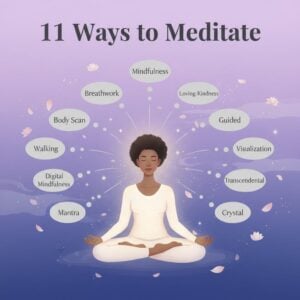

Journal prompts for mindfulness are simple questions that help us notice thoughts, feelings and everyday moments as they happen.
When our minds are busy, it’s hard to slow down long enough to notice what’s actually going on. We might feel tense without realizing it, notice that our thoughts are racing, or move through the day without really taking in what’s around us. Putting those small observations onto a page gives us a moment to pause and re-connect with ourselves.
This kind of reflective writing can be a helpful way to use journal prompts, giving our observations a place to land.
Think of a prompt as an anchor, inviting us into inner exploration. This can be through breath, body, thoughts, emotions, sounds, or our surroundings. Or it might help us reflect on a moment carried over from our meditation session.
And no special stationery is needed, nor is a perfect morning routine or a long meditation session. You can start with one simple prompt. Take one slow, deep breath. Notice what’s here in the present moment.
One breath at a time gives us the chance to pause and reconnect with our core values. To notice who we are, what matters most, and where we want to go from here.
Key Takeaways
- Mindfulness journaling is a way to notice and record thoughts, feelings, sensations, and sounds. It’s about what’s happening around you as you pause.
- Daily journal prompts offer simple ways to track these.
- An entry doesn’t need to be long. A few words or sentences can be enough to capture something you’ve noticed.
- Meditation journaling can happen before or after meditation, or during a quiet time in the day.
- You can return to the same prompt more than once. You may even notice a different response each time.
What Is Mindfulness Journaling?

Mindfulness journaling is a form of journaling that involves writing about what you notice in the present moment. Rather than looking back over your whole day, it redirects attention to what you’re experiencing now. It’s another simple way to explore self-awareness
Mindfulness itself is commonly described as awareness of the present moment without judgment. Research on mindfulness has also explored areas such as mental wellbeing and stress management. Mindfulness journaling combines this present-moment approach with writing, giving you a place to record what you notice.
If you’re curious about how mindfulness journaling compares with other approaches, here’s a look at different types of journals you might want to explore.
Here’s a way to begin: Take a few breaths, centre yourself, and notice what is happening without analysing or judging it. Simply write down what you notice.
How Do You Use Journaling Prompts for Mindfulness?
You can use journaling prompts for mindfulness as a simple starting point. Choose one prompt that feels relevant. Take a few slow breaths, and give yourself a moment to respond.
Read the prompt and allow the answer to flow naturally. No need to find the perfect answer or think about what you should write. Give yourself permission to write whatever comes to mind. Even if it feels unfinished or takes you slightly outside your usual comfort zone.
You can write for a few minutes or stop when you’ve said what you want to say. The aim isn’t to produce a polished journal entry. It’s about giving yourself time to pause and notice your present experience. Over time, this kind of regular check-in might help with becoming more aware of patterns. Such as any recurring negative thoughts, emotions, or physical sensations.
If you’re looking for an easy journal ready to use, here’s a handpicked journal that could be a lovely option. You can still add your own self-care journal prompts alongside the existing ones.
What Should I Write in a Mindfulness Journal?

What you write in a mindfulness journal can include thoughts, feelings, physical sensations, sounds, and details in your surroundings. Or something you noticed during or after meditation.
For example:
Thoughts: “I keep thinking about tomorrow.”
Feelings: “I feel frustrated.”
Physical sensations: “My shoulders feel tense.”
Sounds: “I can hear traffic outside.”
Surroundings: “The room feels warm.”
Meditation: “I noticed my breathing became slower.”
You can also write about a specific moment rather than summarising your whole day. For example: “My chest tightened when I opened my inbox. I noticed I was holding my breath.”
Studies have explored the relationship between putting feelings into words and emotion regulation. Research on affect labeling has examined the effects of putting feelings into words, including through writing.
Writing about thoughts and feelings can be part of expressive writing, which studies examined in relation to emotional and physical health.
Journaling Prompts for Mindfulness
Journaling prompts for mindfulness are simple questions that can guide reflective moments. They can be grouped by different areas of focus, such as thoughts, feelings, physical sensations, sensory awareness, or everyday experiences.
Think of the prompts as a menu rather than a list you need to work through. Choose a theme that feels connected to what you want to explore. Or simply start with a question that catches your attention.
Some prompts may also be useful for meditation journaling. Others might encourage you to reflect on experiences connected with emotional regulation.
Prompts for Present-Moment Awareness

- What is happening around me right now?
- What do I notice through sight, sound, smell, touch, and taste?
- What has been pulling at my attention?
- What changes when I slow down long enough to notice?
- What small detail could I have missed if I had rushed through this moment?
Mindful journaling can start with something as small as a sound, a sensation, or a detail in the room. No need to turn it into a bigger story.
Prompts for Breath Awareness

- Where in my body does my breathing feel easiest?
- Is my breathing shallow, steady, slow, quick, or changing?
- What happens in my body between an inhale and an exhale?
- What thought appears when I bring my attention back to my breath?
- What is it like to notice my breathing without trying to change it?
The breath can be a simple point of focus. You can write about what you notice without trying to make it slower, deeper, or more regular.
Prompts for Body Awareness

- What sensations do I notice in my body right now?
- Where do I notice tension, pressure, warmth, or ease?
- What do I notice about my posture in this moment?
- How does my body feel after I stand, stretch, walk, or sit still?
- What do I notice where my body meets the chair, floor, bed, or ground?
A body scan moves attention through different areas of the body. Writing afterward can give you a way to record particular sensations or moments that stood out.
Prompts for Thoughts and Emotions

- What thought has returned most often today?
- Can I describe this feeling without calling it good or bad?
- What story is my mind telling me?
- What facts do I know, separate from what I fear or assume?
- What emotion would I like to acknowledge before moving on?
You don’t have to figure everything out straight away. Simply write down the thought or name the feeling. There is no need to decide what it means.
If a negative thought starts to spiral, writing it down can create a little distance. If it feels like too much, pause or close the journal. If needed, talking things through with someone can offer another way to work through it.
Prompts for Self-Reflection and Gratitude

- What has occupied more of my attention than I expected?
- What pattern am I beginning to notice in my reactions?
- What feels important to me today?
- What have I overlooked because it seemed too familiar?
- What small moment brought comfort, amusement, or appreciation?
Self-reflection can create space to consider what matters, what has been taking up your attention, and what you may want to understand more clearly. It can be as simple as noticing something that stood out during the day and giving yourself a moment to write about it.
Gratitude journaling can be just as simple. Write down something you appreciated, without needing to make it seem bigger than it was. A warm mug in your hands, a familiar song, or a message from a friend. It can simply be a way of noticing and appreciating something that might otherwise pass by.
Kristin Neff’s self-compassion scale is another resource that looks at how people relate to themselves through areas including self-kindness, common humanity, and mindfulness.
Should I Journal Before or After Meditation?
You can journal before or after meditation. The choice depends on when you feel like writing and what you want to reflect on during your mindfulness session.
Writing beforehand gives you somewhere to put errands, worries, or unfinished conversations that are taking up space in the mind. A few lines are often enough with meditation journaling.
Writing afterward can focus on what you’ve noticed during the session itself as part of your reflection exercises. This might include a recurring thought, a body sensation, a sound, or a change in how you felt.
Neither option is required, and neither is more correct. Some days, writing first feels natural. Other days, sitting quietly before picking up a pen suits the moment better.
What Should I Write After Meditation?

Writing after meditation can be a simple way to capture what stood out during a mindfulness practice. Meditation journaling doesn’t need to rate the experience as good or bad. It can simply record what you noticed and become a useful part of the reflection exercises.
A few questions to consider:
What thoughts appeared most often?
What sensations did I notice?
What distracted my attention?
What did I notice when I returned my attention to my breath?
Is there anything from this session I’d like to remember?
Practical details are worth noting too. You might record where you sat, how long you practised, or whether the room was quiet or noisy.
Looking back at these details may help you notice any patterns. This can be helpful when you’d like to try something different in future sessions.
What Are Good Mindfulness Journal Prompts for Beginners?
Good mindfulness journal prompts for beginners are clear, specific, and easy to answer. A useful starting prompt doesn’t require prior journaling experience or a detailed response.
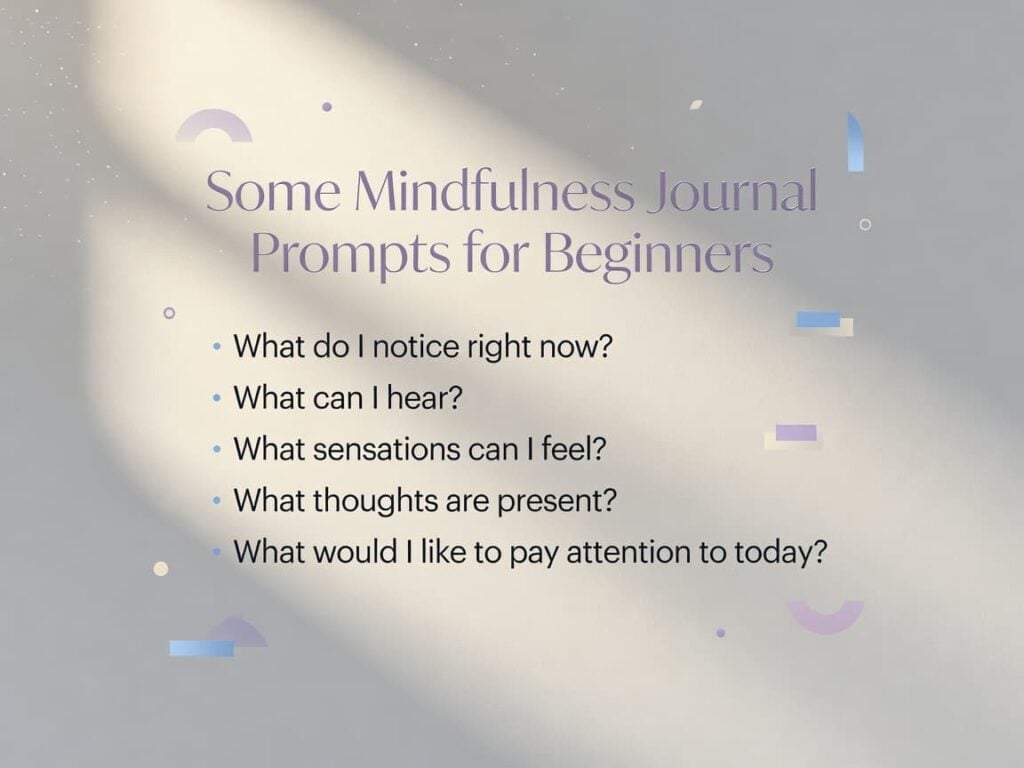
Try simple questions such as:
What do I notice right now?
What can I hear around me?
What physical sensation stands out?
What thought keeps coming to mind?
What feels important to me today?
What did I enjoy about this session?
The best prompt is often one that feels easy to understand and gives you somewhere to start. There is no need to choose a complicated question or search for a deeper meaning.
Some prompts may feel familiar, while others may take you slightly outside your comfort zone. Trying different questions can create space for personal growth without making the practice feel like something you have to get right.
Using a journal with existing prompts can also make getting started easier. A dedicated journal gives you questions to work from when you’re not sure what to write. You can always add your own prompts to tailor the experience to what feels relevant to you. Here’s a handpicked journal that could be worth considering.
If you prefer more freedom, a blank journal like this one leaves space to create your own prompts as you go. Both journal options give you room to find an approach that suits you.
Morning Journal Prompts for Mindfulness
Morning journal prompts for mindfulness can give you a moment to pause and notice your inner experience. A short meditation using breathwork can be part of the morning routine.
Even a one-word mantra, positive affirmation, or intention can help set the tone and energy you’d like to carry into your day.
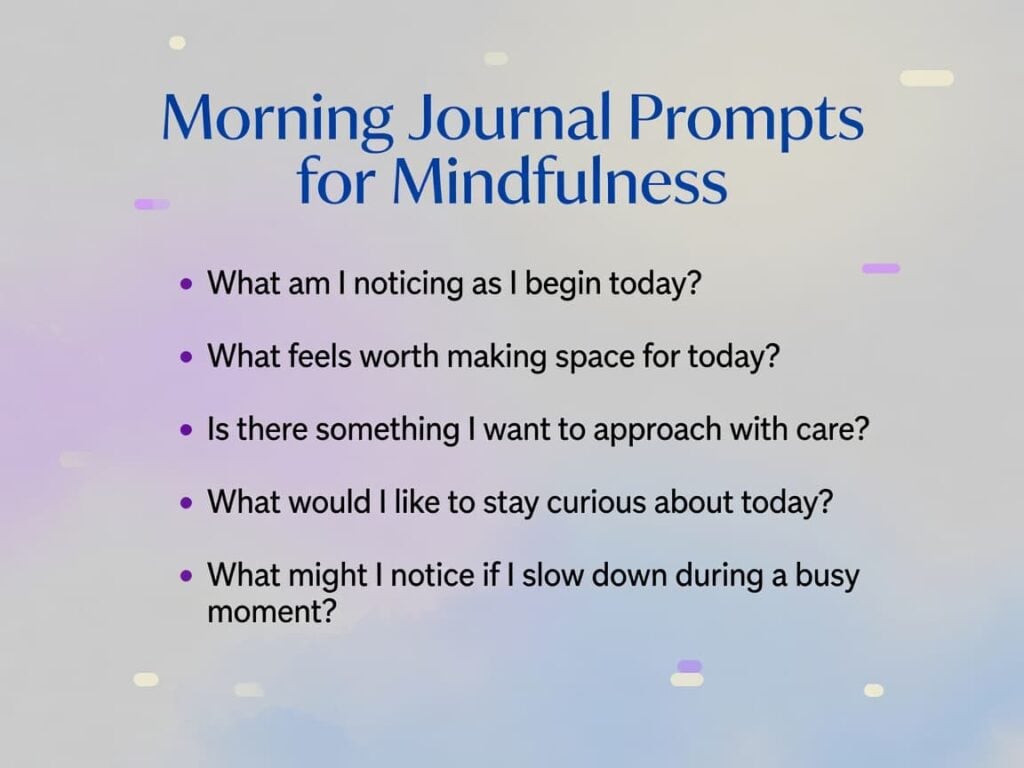
Try a few simple prompts:
How am I feeling this morning?
What is on my mind as I start the day?
What would I like to be more aware of today?
What do I want to make space for today?
What am I looking forward to?
You don’t need to write a long entry. A few words can be enough to check in before your day begins.
These type of self-care journal prompts don’t need to become another task on your morning list. Choose one that speaks to you and let your response be as short or detailed as it naturally feels.
If you like the idea of journaling, future self journaling is another approach worth exploring.
Evening Journal Prompts for Mindfulness
Evening journal prompts for mindfulness are simple questions that give you a quiet moment to reflect on the day. You might write about something that stayed with you, a moment that felt meaningful, or an experience you haven’t had time to think about yet.
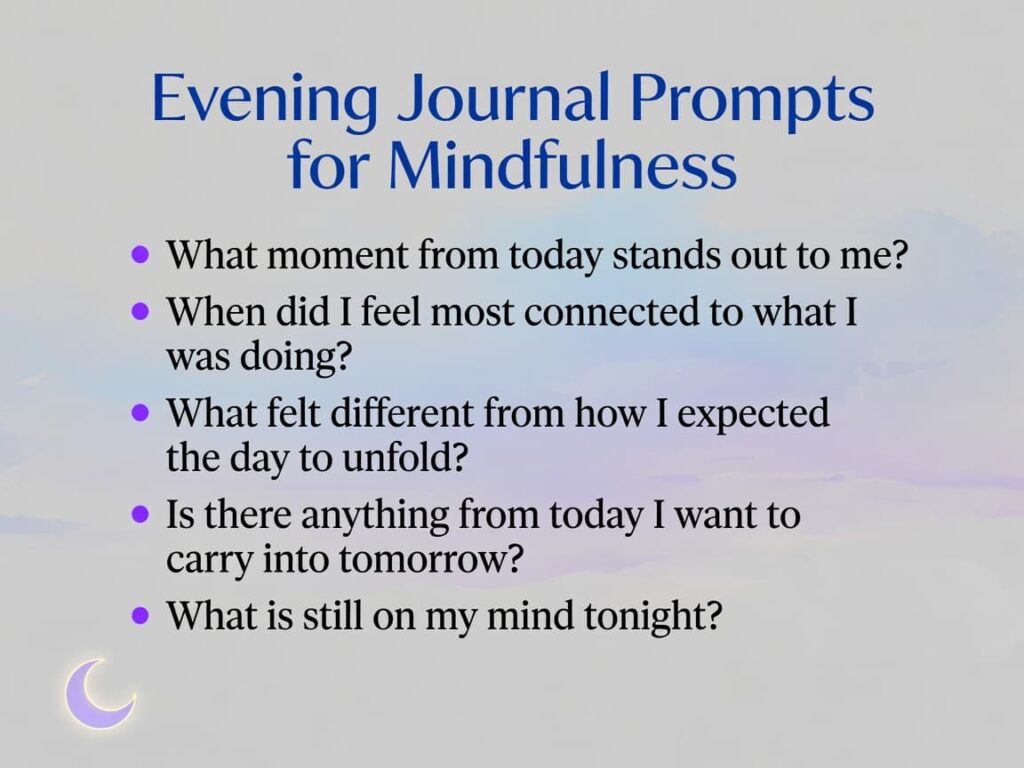
- What moment from today stands out to me?
- When did I feel most connected to what I was doing?
- What felt different from how I expected the day to unfold?
- Is there anything from today I want to carry into tomorrow?
- What is still on my mind tonight?
If something difficult comes to mind, you can write about it without trying to solve it. Simply describe what happened, what you felt, or what you needed in that moment.
There’s no need to find a positive ending or summarise the whole day. A few honest lines can be enough.
Evening journaling can also make room for gratitude journaling, whether it’s a conversation with someone you care about, a quiet cup of tea, or a patch of evening light.
How Long Should a Mindfulness Journal Entry Be?
There’s no set length for a mindfulness journal entry. It can be a few words, a few sentences, or several pages, depending on what you feel like writing that day.
You don’t need to reach a certain word count or spend a set amount of time writing. A quick note can be enough, while on other days you may want to write a longer reflection. Once you’ve written what you want to say, you can put the pen down.
FAQs about Journaling Prompts
Is mindfulness journaling the same as meditation?
Mindfulness journaling and meditation are related, but they are different practices. Mindfulness journaling uses writing to put thoughts, sensations, feelings, or other observations into words. Meditation involves intentionally bringing attention to something, such as the breath, sounds, or body sensations.
The two can be practised separately or together. Mindful journaling can be done on its own, or it can follow a meditation session as a way to write about what was noticed.
Can I practice mindfulness without meditating?
Mindfulness doesn’t have to involve meditation. It can be brought into ordinary activities such as washing dishes, walking, drinking coffee, or writing in a notebook.
It might be as simple as noticing the movement of your hands while washing dishes or noticing the sounds of your footsteps during a walk.
Can I use the same journal prompt every day?
You can return to the same journal prompt whenever it feels useful. The prompt may stay the same, while your response can change from one day to the next. A familiar question can also make it easier to notice what feels different over time.
What is the difference between mindfulness journaling and gratitude journaling?
Mindfulness journaling can explore what you notice in the present moment, including thoughts, feelings, sensations, surroundings, or experiences. Gratitude journaling has a more specific focus on recognising and writing about things you appreciate.
The two can overlap. Mindful journaling leaves the subject open to whatever you notice, while gratitude journaling keeps the writing centred on appreciation.
Final Thoughts on Journaling Prompts for Mindfulness
Journaling prompts for mindfulness can offer a simple place to begin. One line can be enough to pause and put into words what you notice.
You can use them in whatever way feels comfortable. You might write before meditation, after meditation, or during a quiet moment in your day. Find what feels right and let journaling become part of your mindful living routine.
Choose one prompt from this guide and see where it takes you. Over time, these small moments of reflection may become a simple part of your emotional wellbeing and create space for a little more inner peace.
If you’d like to explore more ideas around journaling and positive energy, here’s a few posts with more prompts, information and inspiration.