Originally written in 2026, fully updated on 2nd Feb, 2026.

Have you ever noticed how your mind can be your biggest cheerleader one minute, and your harshest judge the next? One moment, you feel capable and clear about what you want. The next minute, that familiar voice shows up again. You know, the one shaped by old internal programming, quietly saying, “not good enough.” This is where empowering your mindset really starts.
It’s about understanding that voice, rather than fighting or ignoring it.
The inner critic often gets louder right before a big moment. It tends to show up when you’re starting a new habit, making a brave decision, or stepping outside of your comfort zone. And, if it goes unchecked, it can slowly wear down your self-trust without you even noticing.
That’s why this approach isn’t about forcing yourself to “think positive.” It’s about building a few easy, repeatable self-care habits that stop and calm the inner critic before it runs its own show. When these habits stick, you’re empowering your mindset for the long haul. The exhaustion of ‘trying’ fades away, confidence takes over, and self-trust becomes second nature.
Key Takeaways: Empowering Your Mindset
- Build self-awareness gradually: Taking small actions, even just a couple of minutes on a task you’ve been avoiding, can help reduce the influence of the inner critic.
- Incorporate simple daily habits: Quick journaling, brief stretches with deep breathing, or short mental scripts like “One step and breath at a time” support consistency and reflection.
- Use affirmations to remind yourself: Phrases such as “I know I can do this,” “I am doing this now,” or “Progress is more important than perfection” can be repeated when self-critical thoughts arise, especially before taking action.
- Reframe negative thoughts: Notice a thought and express it in a simple format, e.g., “I feel [emotion], but [reminder of past success].” This approach encourages thoughtful responses rather than automatic reactions.
What the Inner Critic Is and Why It Feels So Real

Our inner critic doesn’t mean we’re broken. It’s usually our internal safety system. It’s learned patterns and rules from past experiences. Most of the time it tries to protect us with control, judgment, or worst-case thinking.
Of course, it can feel very real because it’s not just mental. It can also show up physically.
Stress can make our chests feel tight, our hearts race, and our thinking narrow. That “tunnel vision” makes it harder to notice balanced thoughts, creativity, or self-kindness.
We don’t just think these disempowering thoughts. We often feel them.
Research shows that self-criticism tends to link with higher stress and more repetitive negative thinking.
On the other hand self-compassion practices are associated with lower self-criticism and improved coping. Here’s a systematic review on self-compassion interventions reducing self-criticism.
Practical takeaway: Mindset work often goes more smoothly when our nervous system feels settled. When our bodies are calmer, it’s easier to think clearly and make kinder, more considered choices.
Build self-awareness: Spot your inner critic (words, tone, and body cues)
When we catch the critic mid-sentence, we interrupt its power. Here’s a simple checklist that may help:
Common automatic negative thoughts
- “Always,” “never,” “everyone,” “no one”
- “Should,” “must,” “what’s wrong with me?”
- “Not enough,” “too much,” “we’re behind”
Common critic tone
- Harsh
- Urgent
- All-or-nothing, fixed mindset (no room for learning)
Common body cues
- Tight jaw or clenched teeth
- Shallow breathing
- Shoulders up near our ears
- Heavy belly, tight chest, or restless legs
The 10-second pause practice
- Stop — pause for at least a single beat.
- Label it—even give it a funny nickname to redirect its serious nature.
- Remember to Breathe — and slow exhales to help settle our body.
- Choose a small, helpful next step — send that email, or rewrite a sentence.

We’re not trying to ‘win’ against our thoughts. We’re guiding ourselves with more of a mindfulness practice of awareness. Catching the critic mid-thought helps us interrupt its automatic pull and make decisions with a clearer, calmer mind.
Empowering Your Mindset with 5 Easy Habits In Calming the Inner Critic
When it comes to empowering your mindset, mental habits work best as small, repeatable actions rather than big emotional shifts.
We’re not trying to overhaul our thinking overnight. We’re simply creating a more supportive pattern. One habit at a time.
Each habit can be practical and grounding.
- No forcing positive thinking.
- No arguing with thoughts.
Just simple ways to respond differently when the inner critic shows up.
For each habit, we’ll cover:
- What it is.
- Why it helps (brief and practical.)
- A simple script you can use or even tweak it to suit the new you.
- A 1-minute version for busy days.
Habit 1: Name It to Tame It

(Label disempowering thoughts, don’t argue with them)
What it is:
We give disempowering thoughts a label or nickname. This helps us create a little space between ourselves and the voice, instead of getting pulled into it all.
Why it helps:
Labelling thoughts reduces how strongly we identify with them. When we name the voice, we’re less likely to treat every thought as a fact we have to follow.
Simple scripts you can try :
- “That’s the disempowering thoughts talking again.”
- “Noted. That’s the pretend Judge.”
- “I hear the Worrier coming in again.”
Pick one label that fits your personal inner critic:
- The Judge —who’s sharp, critical, rule-focused
- The Worrier — who plans for the worst-case scenarios as usual.
- The Perfectionist — when nothing counts unless it’s flawless.
Also, if positive affirmations support you, then keep them realistic and grounded. Simple, believable affirmative statements tend to work better than overly positive ones.
You can explore helpful examples here: https://positivezenenergy.com/confidence-affirmations-to-believe-in-your-new-self/
One important distinction: We label the voice, not ourselves.
- Not: “I’m such a mess.”
- Instead: “The Perfectionist is loud today.”
1-minute version (quick step):
- Label it: “This is the Judge.”
- Exhale slowly once.
- Start one small task for two minutes, just to get on with moving forward.
Habit 2: Use an “Is This Helpful?” Script

(Respond in a quick yet mindful way without getting pulled too much into it’s story)
What it is:
Instead of debating or analyzing disempowering thoughts, we can respond with a short, neutral phrase. The goal isn’t to prove the thought wrong. It’s to pause the spiral and spinning thoughts and re-align oneself with a success-oriented mindset.
Why it helps:
Simple scripts shift our focus away from limiting beliefs and self-sabotage. They help us pause the spiral and get clear on the next step, so we can keep setting goals without getting stuck
Choose one script you’ll actually use:
- “Is this helpful right now?”
- “Thanks, I’ve got it from here.”
- “Maybe, but I’m doing this anyway.”
When to use each one:
- Before a meeting or conversation:
“Is this helpful right now?”
This keeps attention on the task instead of the commentary. - While learning something new:
“Maybe, but I’m doing this anyway.”
This keeps us moving forward without waiting to feel fully certain or ready. - After a mishap (when things don’t go as planned):
“Okay, noted — I’ll take some different steps now.”
This helps end the replay loop and shift into problem-solving.
If you want more ideas for quieting disempowering thoughts, this Calm guide to negative self-talk has additional examples you can use.
1-minute version (busy days):
- Pick one script.
- Say it once out loud.
- Take one small action that keeps you moving. Send the message, open the document, begin one sentence.
Using simple scripts regularly helps to shift thought patterns in a more positive direction. Supporting the process and empowering your mindset.
Habit 3: The “But” Reframe journal, add proof, not hype

What it is: A simple journal format that acknowledges feelings while keeping our perspective grounded and more factual.
How it helps: You notice your emotions without getting swept up in them. Taking responsibility for the next step with more mindful awareness. This helps balance the story and supports more empowering beliefs.
Here’s a format you might want to try:
- “I feel , BUT .”
The power is in the second blank. Here, we add real evidence — past wins, small successes, or facts — not forced confidence. Also by practicing gratitude can help us notice these proofs and make the reframe feel genuine.
5 prompts you might want to rotate
- “I feel nervous, BUT I can take 10 minutes to prepare and do my best now.”
- “I feel behind, BUT I have handled tough weeks before with success and can handle this too.”
- I feel rejected, BUT this doesn’t define my worth or my ability to connect with more supportive relationships.”
- “I feel messy, BUT small steps are progress and I’m still moving forward now.”
- “I feel doubtful, BUT I am learning, growing, and showing up every time.”
One filled example
- “I feel like I’m going to mess this up, BUT I’ve done uncomfortable things before. And I will ask questions if I get stuck.”
By tracking 3 lines per day for 7 days, you’ll be able to identify any thought patterns and taking small steps toward empowering your mindset.
If you’d like more ideas for journaling — guided, structured, or free-form — here’s a post that can help you find the journal style that fits you. https://positivezenenergy.com/types-of-journaling-methods-you-can-follow/.
1-minute version for busy days:
- Write just one line: “I feel , BUT .”
- Add one quick proof: “because I already ___.”
This keeps the practice simple while still giving your mind a factual, calming reminder that balances the feeling with evidence.
Habit 4: One-Minute Self-Compassion — Empowering Your Mindset with Kindness Energy

What it is: A short practice that acknowledges our struggles without letting them take over our real focus or derail us from our life’s future vision.
Why it helps: Self-compassion reduces the body’s threat response, which can fuel harsh self-talk. Over time, it supports calmer, more balanced thinking while cultivating kindness energy and empowering your mindset.
Self-compassion has three simple parts:
- Kindness: you deserve to talk to yourself with care, not criticism.
- Common humanity: remember we’re not alone in our struggles.
- Mindfulness: notice what’s happening without
- getting caught up in it all.
Quick compassionate phrases:
- “This is hard, but I’m not alone.”
- “I can be kind to myself while I figure this out a little more.”
Research often links self-compassion practices with lower self-criticism and better resilience. For a practical take from therapists on everyday self-compassion, see this article: silencing the inner critic with self-compassion .
3-sentence compassionate letter template:
- “I’m noticing I feel ___ right now.”
- “It makes sense, because ___ (be mindful, not dramatic).”
- “What I need most is ___, and I can give myself a small dose of that today.”
1-minute version for busy days:
- Place one hand on your chest.
- Say: “This is hard. But I’m standing in my power right here, right now.”
- Take one slow breath out, releasing the energy and breathing in new fresh energy. Your new fresh begins with your new breath in right now!
And, if you’re curious about how affirmations fit into all of this here’s post to read on: https://positivezenenergy.com/do-positive-daily-affirmations-actually-work/
Habit 5: A Body-Based Reset to Calm the Nervous System (Breath, Touch, Grounding)

What it is: We calm the body first, so the mind has space to choose helpful, empowering thoughts instead of getting caught in disempowering loops.
Why it helps: Lowering the stress response gives the brain more access to flexible, clear thinking.
Pick one of these quick resets (all under 1 minute):
Option A: Hand-on-Chest Breathing
- Place a hand gently on your chest.
- Inhale slowly through your nose.
- Exhale slightly longer than you inhale, even by just a second.
Option B: Butterfly Hug Tapping
- Cross your arms over your chest, hands resting on your upper arms.
- Gently tap your arms from left and then to the right in a nice slow and steady rhythm. Pay attention to how it feels and notice any small sensations or shifts in your body.
- Keep your gaze soft and relaxed.
Option C: Feet-on-Floor Grounding
- Plant both feet firmly on the floor.
- Quietly observe and name five things in your surroundings.
- Let your shoulders drop and relax.
These resets can be helpful when we notice stress, self-doubt, or tension building. If feelings of anxiety or overwhelm are frequent or intense, it’s always best to reach out to professional support and care.
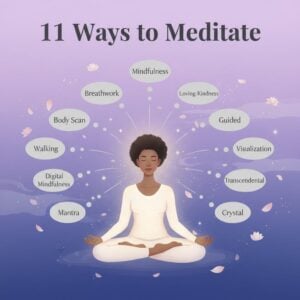
Also, if adding a meditation practice feels helpful, you might explore different meditation options that suit your lifestyle. Did you know that even walking meditation counts. Here’s a general guide for various meditations: https://positivezenenergy.com/different-ways-to-meditate/
Make These Habits Stick: Choose A Simple Weekly Plan
Showing up consistently matters more than trying to do everything at once.
We’re building small, repeatable habits that help work with the inner critic. At the same time also strengthening and empowering our mindset.
Common habits to watch for (most, if not all of us do these):
- Trying to change too many things at once can feel overwhelming and make habits harder to stick to.
- Arguing with our thoughts as if they were facts or courtroom evidence.
- Waiting to feel confident before taking any action can hold us back. Often, confidence grows as we take the first step.
Simple “if–then” plans (Tiny but powerful):
- If we notice the critic, then we label it and take one slow breath.
- If we make a mistake, then we say, “Okay, noted — I’ll try some action using different steps now.”
- If we start comparing ourselves to others, then we do a 60-second body reset. Calming the nervous system and giving our mind a moment to focus on our own progress.
If the inner critic taps into deep shame, past trauma, or persistent low mood, getting professional support can help us cope more effectively.
Therapy, coaching, and support groups aren’t a last resort. They provide a safe space for learning, reflection, and personal growth. They help us to look at ourselves from a different lens.
Your 7-Day Starter Plan for Nurturing and Empowering Mindset

Try these as a morning ritual when possible. Short, consistent practice matters more than trying to perfect it all.
- Day 1 (Habit 1): Label the critic once today, even if it’s after the fact.
- Day 2 (Habit 2): Pick one script and use it one time.
- Day 3 (Habit 3): Write one “I feel , BUT ” line.
- Day 4 (Habit 4): Do the 3-sentence compassionate letter, or just one sentence if you’re tired.
- Day 5 (Habit 5): Try one body reset, under 60 seconds.
- Day 6 (Mix): Use Habit 1 + Habit 5 together — label, then breathe.
- Day 7 (2-minute review): Ask: “What helped most? What emotional milestones stood out?” Write the answer in two lines.
If you miss a day, don’t worry — restart tomorrow. No catch-up needed.
Troubleshooting: Overcoming obstacles when the inner critic gets louder
Some moments trigger the critic fast. Remember loud doesn’t mean it’s true.
Here are five common triggers. Try using one small action and one sentence that feels right for you in the moment.
- When we’re tired or haven’t slept well
- Action: Drink water, have a light, yet nourishing snack, and ease the pace for the moment.
- Sentence: I’m tired right now, so I’ll respond with care, not pressure.
- Conflict or tension with someone
- Action: Unclench your jaw, slow your exhale, and focus on one thing you can control with mindfulness.
- Sentence: “I can stay calm and am maintaining my boundaries now.”
- Big goals and new beginnings
- Action: Break it into the next small step. Even just 10 minutes counts.
- Sentence: “It’s okay to start with small steps and learn as I go and grow.”
- After a mistake
- Action: Ask yourself, “What’s the lesson in this one?”
- Sentence: “One mistake doesn’t define me. This just shows me that I need to do it differently next time.
- Social media and comparison
- Action: Close the app for a short break. Notice something real. Like the sky, the plants, or even your amazing hard working hands.
- Sentence: “Their highlight reel isn’t my life.”
If you want structured exercises for building an empowered mindset, Positive Psychology offers practical tools like these inner critic worksheets.
And if you’re curious how self-critical rumination can intensify stress, this research summary shares more on: The effects of self-critical rumination on shame and stress.
FAQs on Empowering Your Mindset
How can I identify and quiet my inner critic?
Building self-awareness, taking one small action at a time, so you’re not letting the inner critic stop you. Even spending just two minutes starting a task you’ve been putting off shows yourself that you’re still moving forward and starts to quiet the critic.
What are simple daily habits to empower my growth mindset?
By keeping things really easy, otherwise it doesn’t stick.
- Write a quick three-line journal entry.
- Take 60 seconds to stretch, breathe deeply, and ground yourself.
- Try a short mental script, like “I’ve got this” or “One step and breath at a time.”
By practicing these habits daily, you’re showing yourself you can do this. Gradually empowering your mindset and calming the inner critic.
Which self-talk statements help me feel calmer and build self-confidence?
Remind yourself with affirmative phrases like: “I know I can do this”, “I am doing this now” or “Progress is more important than perfection.”
Repeat them when you feel the inner critic rising, especially right before taking action.
How can I reframe negative thoughts quickly?
Notice the thought and say it out loud in a simple “I feel , but ” format.
For example: “I feel nervous, but I’ve succeeded throughout challenges before.”
Adding real proof like this reminds your mind that you’ve overcome challenging situations before. This helps the mind respond with thoughtful actions instead of reacting automatically to fear.
Final Thoughts on Empowering Your Mindset

We don’t have to eliminate the inner critic to live well. We can notice it, label it and take a moment to breathe and ground ourselves. Still choosing actions that reflect supportive beliefs we’re intentionally strengthening. That’s at least one way for empowering your mindset.
Starting small matters. Choose one habit to practice this week. Keep it simple enough that it fits into everyday life. The goal isn’t about perfectionism. The goal is to notice patterns and respond a little more intentionally each time.
An empowering mindset grows through awareness, choice, and commitment. You’ve got this!