
Originally written on 24th June, 2021. Updated on 4th October, 2026.

Ever wondered what it would actually be like to use hypnosis for clearing negativity from your life?
We all know negative thoughts can feel repetitive. A stressful conversation gets replayed. A small mistake can sometimes turn into harsh self-talk. One worrying thought can lead to another until the whole day feels heavier than it really needs to be.
When we talk about negativity in this post, we mean the patterns we don’t want but still keep circling back. This includes self-criticism, worry, and feelings that weigh us down. And working through negativity isn’t about pretending to be positive all the time or blocking feelings during challenging situations.
Instead, it’s about knowing which mindset tools can be useful in times like these. Ever wondered about using hypnosis for clearing negativity from your life? Hypnosis could be a helpful way to redirect those unwanted thought patterns and tap into your more productive and positive side.
Key Takeaways
Hypnosis uses focused attention and deep relaxation. Usually guided by verbal suggestions and mental images.
Before a self-hypnosis session, a person can choose a professionally written script or a ready-made audio that fits their goals.
A clinical hypnotherapist keeps a person’s needs in mind, tailoring suggestions to their goal. For example, releasing harsh self-talk or self-criticism.
Research found that forcing an unwanted thought away can make it return more prominently later. Redirecting thoughts is another option, rather than pushing them away.
Responses to hypnosis vary from person to person, so approaching it with curiosity is a good place to start.
What Is Self-Hypnosis for Clearing Negativity?
Self-hypnosis for clearing negativity combines relaxation, focused attention, and carefully chosen suggestions that target recurring negative thoughts.
Self-hypnosis is one way to use hypnosis without a therapist in the room. Normally, clinical hypnotherapists write the scripts and guide the audio recordings. That lets a person listen to them, from the comfort of their own home. Each guided hypnosis session usually leads into a state of relaxation and calm, followed by suggestions aimed at the person’s goal.
Along the way, attention becomes more focused on one specific thought pattern or intention. Throughout, a person usually stays aware and in control of what is happening.
Can Self-Hypnosis Help With Negative Thoughts?
Self-hypnosis may be a supportive way to work with negative thoughts. In a Stanford-led study of more than 84,000 app users, self-hypnosis sessions were followed by lower self-rated stress.
Wording plays a part too. Suggestions tend to work best when a person feels relaxed, open to them, and able to picture them leading to results. That’s why suggestions are usually worded to resonate with a person’s future self. It can be the version of them who is in the process of making the change, or has already made the change.

What's the First Step in Clearing Negativity?
The first step in clearing negativity is trying to pinpoint it, since “negativity” can mean a lot of different things. Negative thoughts can feel automatic, so begin with a recent moment, such as a situation that left you feeling stressed or doubting yourself. From there, you may want to try putting a feeling into words. It could be a simple starting point.
Try writing down how that moment felt, using a word such as:
worry
frustration
fear
guilt
self-doubt
That word might be related to, and part of, the session. For example: for self-doubt, a session might be built around the intention to release limiting beliefs, specifically, one’s view about ability or worth.
Why Do Negative Thought Loops Persist?
Negative thought loops persist partly because repetition makes a pattern familiar. Researchers describe repetitive negative thinking as repeated, prolonged thoughts about one’s experiences and concerns. One theory suggests that low mood can trigger rumination, and rumination can deepen the mood, so the loop keeps itself going.
Over time, a well-worn reaction can become one of those old behavioral patterns that shows up quickly. A familiar thought is not necessarily an accurate one. It simply means the pattern is easy to fall into. That familiarity is also part of why these thoughts can feel so automatic.
Why Are Negative Thoughts So Automatic?
Negative thoughts can feel automatic because they often arrive before there has been time to question them. A delayed message might become “something must be wrong.” One uncomfortable moment can grow into a much larger story.
That escalation often follows a recognizable pattern. A few common ones might be something like:
All-or-nothing thinking: seeing a situation in black-and-white terms, with no middle ground.
Overgeneralization: treating one setback as proof of a never-ending pattern.
Jumping to conclusions: assuming the worst without clear evidence, whether that’s guessing what someone else is thinking or predicting how things will turn out.
Catastrophizing: blowing a problem out of proportion.
Should statements: pushing yourself with “should” and “must,” which tends to leave guilt in its place.
And the body can join in too. Stress can affect the body in several ways: the shoulders tighten, the stomach feels unsettled, and sleep becomes harder. That physical response can make a thought feel even more convincing.
Does Ignoring Negative Thoughts Make Them Worse?
Ignoring negative thoughts can backfire when it means actively pushing them away. In classic research on thought suppression, people were asked not to think about a white bear. Afterward, they thought about it more than people who’d been asked to think about it from the start.
Self-hypnosis works with the thought differently. Rather than pushing it away, attention is guided toward one calming focus, such as an image, a physical sensation, or slow, steady breathing. Once attention has settled there, suggestions tailored to work on that goal are introduced.
How Do You Practice Hypnosis for Clearing Negativity?
Practicing hypnosis for clearing negativity starts with settling the body, then introducing a suggestion tied to what you’re working on, guiding your own self through the process.
No special preparation is needed, although comfortable clothing can help. The full walkthrough, including whether to use an audio or your own voice, is covered step by step further down in this post.
What Role Does Relaxation Play in Hypnosis?

Relaxation plays a central role in this practice, since hypnosis usually pairs deep relaxation with focused concentration. That’s why a session often begins with relaxation and letting go.
A simple body scan is one way to start, moving attention slowly from the jaw through the chest to the hands. The intention is letting go of tension as it passes through each area.
Mental imagery is one of hypnosis’s two main strategies, so a session may also picture a safe place, such as a quiet beach, garden, or forest path, somewhere for the mind to rest while the body settles. A recording or script can guide you through both the body scan and the calm image. Inner peace may be part of the intention behind a session, as a personal aim.
A Simple Self-Hypnosis Routine

A simple self-hypnosis routine for negative thought patterns comes down to choosing a guided audio or recording a written script in your own voice. The recording does the guiding, so the steps below are mostly about getting ready and listening. How long a session takes depends on the recording you select.
Step 1: Pick What You Want to Work On
Bring to mind the moment and the word from the first-step exercise. Then ask yourself: what negative patterns or behaviors would I like to work on and let go of? This can also include negative beliefs, such as ideas about ability or worth.
Audios and scripts cover many different themes, so match one as closely as you can to your specific goal. Choose the words that best describe your situation and a vision you can picture yourself in.
Step 2: Settle the Body
Pick your private spot at home where nobody will disturb you. This is your time to relax, let go, and focus on your intentions. Comfortable clothes help the body settle, especially when the recording includes breathing techniques. You can choose to sit or lie down, however feels best, while listening to the suggestions.
Step 3: Listen and Follow the Recording
Now it’s time to listen. A session typically begins with a soothing voice and calming images, so choose a voice you like to listen to and relax with. Prefer your own? You can record a professionally written script in your own voice instead.
A deep breath is a good way to start, since a natural relaxation response follows an exhale. From there, the session guides you into relaxation.
After this, the suggestions begin, aimed at your goal. You may be invited to picture yourself reaching it, or already in the process of reaching it, and reconnecting with your positive qualities along the way.
Some sessions also end with an anchor, a simple cue such as a word, a sound, or a light touch of your fingers, paired with that calm feeling.
Step 4: Finish Gradually
At the end of the practice, take a few deeper breaths and slowly bring your full attention back to the room. Open your eyes when you’re ready, and take a moment before getting up.
Is a Ready-Made Audio or Script Helpful?
A ready-made hypnosis audio and a personal script can both be used for self-hypnosis. The choice mainly comes down to what resonates with you more.
A professionally produced recording provides the structure, pacing, relaxation cues, and suggestions. Another option is recording your own voice using a professionally written script from a clinical hypnotherapist.
How Do You Know If the Practice Is Helping?
There’s no fixed timeline. New negative thoughts will keep showing up, that’s normal, and it doesn’t mean the practice isn’t working. What changes over time is the pattern itself: how a familiar thought is met, and how much weight it carries.
Some sessions, attention moves into the recording quickly. Other times, the mind stays busy and the session feels fairly ordinary. Neither means the practice has failed, noticing when attention has wandered and bringing it back is part of the practice itself.
Signs of change tend to be subtle rather than dramatic, such as:
A negative spiral noticed earlier than usual
A harsh thought questioned instead of automatically believed
A stressful moment that passes without turning into hours of rumination
A bit more mental clarity since attention isn’t as stuck on the same recurring thought
An emotional release, which doesn’t have to be a big moment, sometimes it’s just feeling a bit more free within yourself
Personal transformation, feeling more empowered in knowing how to manage thoughts before they steer into a negative spiral
Helpful Habits to Pair With Hypnosis for Negativity
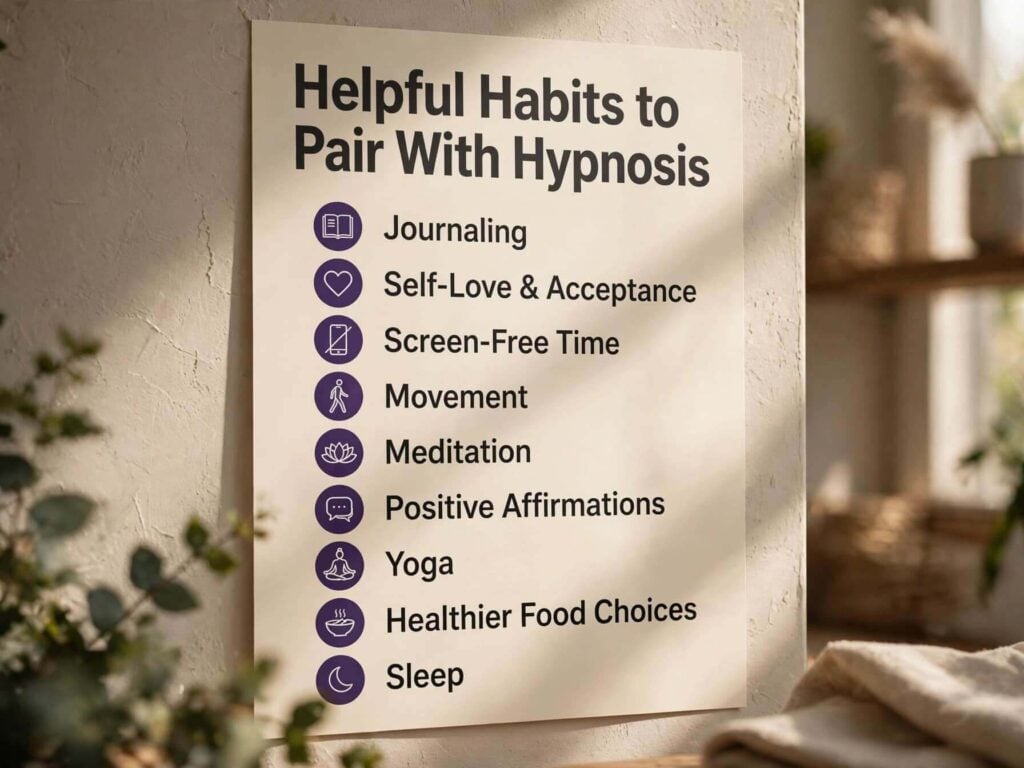
Self-hypnosis doesn’t have to work alone. It can sit alongside other habits that shift the conditions negative thought patterns tend to grow in:
Journaling: jotting down thoughts to get them out of your head and onto paper. A journal is like having an accountability partner, it helps you see what’s true and what to let go of.
Self-love and acceptance: picturing your future self this way is something journaling, affirmations, or a hypnosis session can all support.
Screen-free time: setting aside a regular stretch of the day away from screens, out in the fresh air, giving the mind room to unwind and feel free.
Movement: doesn’t need to be intense, a daily walk is enough to get the body moving and the positive energy flowing. Breathing in deeply that fresh, crisp air, filling our body and lungs, we recognize that healing life force within us that keeps us going.
Meditation: doesn’t have to mean sitting cross-legged, there are several different styles to try.
Positive affirmations: short, repeated statements that support the same kind of suggestion work used in self-hypnosis.
Yoga: combines movement, breath, and stillness, a physical complement to the relaxation side of hypnosis.
Healthier food choices: what you eat can be part of the wider picture alongside how you think and feel.
Sleep: winding down properly before bed matters. Rather than doom-scrolling until your eyes close and your brain hurts, give your mind the space it needs to actually rest. The kind of healing sleep that makes the next day easier. BTW, there are also deep sleep hypnosis audios available if this is a goal you’d like to tackle at some point.
Together, these habits are sometimes described as self-healing, small, everyday choices that support how a person feels and thinks. Over time, they can support that same personal transformation we talked about earlier, right alongside hypnosis.
Frequently Asked Questions
How long should a guided hypnosis session last for clearing negativity?
There’s no set length. It depends on the recording or script you choose that resonates with your intention of clearing negativity. Even shorter, but regular sessions tend to be easier to stick with than long, one-off, occasional ones.
Can hypnosis for clearing negativity from your life be practiced every day?
Self-hypnosis can be practiced daily. Repetition helps new suggestions strengthen over time. Regular sessions have more chances of sticking than one-off sessions.
Can hypnosis really help get rid of negative thoughts?
Not entirely, and no method truly does, new thoughts will always show up. It’s better viewed as a tool that supports relaxation and helps change how a thought is responded to, rather than something that removes thoughts altogether.
Final Thoughts
Hypnosis for clearing negativity from your life isn’t about forcing unwanted thoughts away or trying to feel positive all the time. It’s about learning to notice familiar, unhelpful thoughts without automatically letting them take over your entire day.
With practice, that small shift can create a bit more emotional freedom. For some, it feels like a positive transformation, a gradual way to let go of negativity and make more space for what genuinely matters.
So instead of asking, “How do I get rid of this negativity in my life?”, you might try: “How would I like to respond the next time this thought shows up?”
This is where mindset tools, such as hypnosis, can become helpful. Change doesn’t always start dramatically, sometimes it’s simply meeting a familiar pattern a little differently each time. One small step toward the life you want to build. If empowering your mindset is something you’d like to explore further, or you’re curious whether hypnosis could help with anxiety, those are good next reads.
If you’d like to explore a library of hypnosis audios and scripts, you’ll find plenty there to start with.